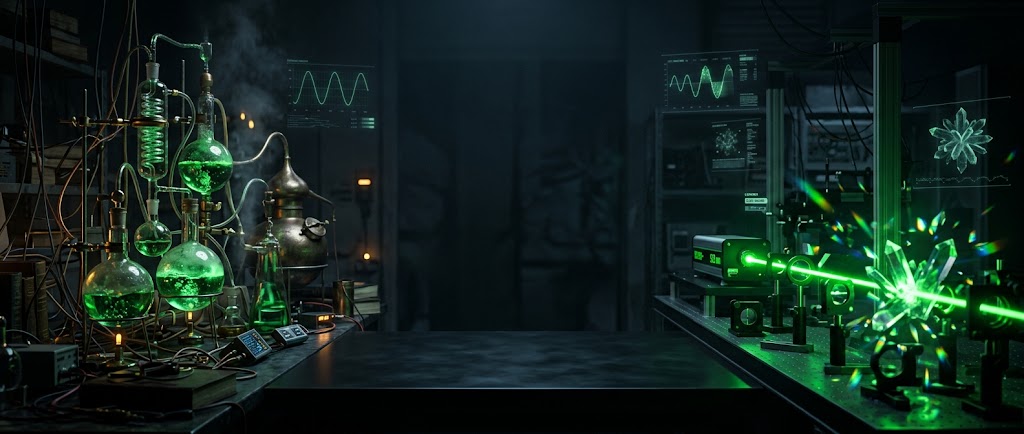
What is Crystal Madness?
Honestly? We turned plants into crystals, and now we need smart people to figure out what they can actually do
It sounds absurd but it’s real. Through a process of botanical extraction, electrochemical reduction, and phase-shifting, we managed to convert living plant biopolymers down into stable, solid-state nanophotonic crystals. When you add water back to them, they rehydrate into an active, light-bending fluid that interacts with lasers, electricity, and optics in ways we are still mapping
The Challenge: We are putting these crystals into the hands of anyone willing to test them. Take a sample, put it under a microscope, shine a laser through it, or test its electrical conductivity. Whatever happens, log your results on the site. The madness is on everyone else—let’s see what happens when you push the matrix
The following guidelines govern independent researchers, makers, and observers taking the crystalline challenge on crystalmadness.org. These rules establish the testing framework for rehydrating, analyzing, and stress-testing our extracted solid-state plant matrices across optical, electrical, and structural domains.
Step 1: The Principle of Reconstitution
You will receive your sample in a dry, stable state—either as a solid-state crystal matrix or biopolymer paper disk.
- The Directive: Rehydrate the sample using pure distilled water or high-purity ethanol in a controlled ratio (targeting an active colloidal fluid baseline).
- Observation: Document the phase shift from dry solid back into active, high-density metafluid. Note dissolution rate, interfacial tension, and visual anomalies during the rehydration curve.
Step 2: Multi-Domain Stress Testing
There are no restrictive use-cases or pre-approved experimental boundaries. Challengers are encouraged to deploy their own equipment and methodologies across three primary vectors:
- Shine a laser on it
- Pump some voltage into it
- Watch it crystallize
Step 3: Observational Telemetry Logging
- Post your data (coming soon).
Step 4: Safety & Material Handling
Standard Laboratory Precautions: Handle all botanical extracts and chemical additions with standard protective gear (gloves, eye protection).
- Containment: Maintain clean workspace protocols. While the matrix originates from natural botanical extraction, its electrochemical and non-Newtonian behavior under multi-domain testing requires careful containment and micro-pipette handling.